
If you ask, “are cats color blind,” the short answer is: only partly. Cats see color, but their palette is narrower than ours. Blues and yellows usually stand out better than reds, pinks, and oranges.
| Question | Quick answer |
|---|---|
| Only black and white? | No. Feline vision includes color. |
| Easiest colors to notice? | Blue and yellow are among the clearest. |
| Harder colors? | Red, pink, orange, and some greens can look muted. |
| Low-light vision? | Much stronger than human low-light vision, but not true darkness. |
| Why the difference? | The retina favors light and motion more than rich color detail. |
| Best toy strategy? | Use visible colors plus strong contrast and movement. |
Felines are not completely color blind. They see a narrower, less vivid range than most people do. Blue and yellow tones are easier to distinguish, while reds and some greens can look muted, grayish, or similar. Their eyes favor low-light vision and motion more than rich color detail.
Key takeaways
- Feline vision is colorful, not simply black and white.
- Blue and yellow are usually easier to separate than red and green.
- Color looks less saturated than it does to most people.
- Movement, brightness, and contrast can matter more than hue.
- Low-light eyesight is a major strength, but complete darkness still blocks vision.
Are Cats Color Blind or Do They See Some Colors?
The phrase “color blind” can be misleading here. A healthy feline does not experience a grayscale world. Veterinary sources agree that its usable color range is more limited than normal human color vision.
Researchers still debate the exact details of feline color perception. Some sources describe a mainly blue-and-yellow system, while others describe additional weak cone responses. The practical result stays similar: warm colors are harder to separate, and many hues look less vivid.
What Colors Can a Cat See Best?
Blue is one of the easiest colors for a cat to distinguish. Yellow also tends to remain visible, with some greenish shades depending on brightness. Red-heavy colors lose much of their distinctiveness and may blend with nearby tones.
| Color family | Likely appearance | Practical takeaway |
|---|---|---|
| Blue | Relatively distinct | Useful for toys and targets |
| Yellow | Usually visible | Often stands out on darker floors |
| Green | Variable and muted | Contrast matters more than exact shade |
| Red and orange | Duller or harder to separate | Movement can matter more than color |
| Pink | Muted and less distinct | Choose a contrasting background |
| Purple | May shift toward blue | Blue content can make it more noticeable |
No chart can perfectly recreate a feline visual experience. Color depends on light, brightness, object size, and surrounding contrast. A classic behavioral study also found that stimulus size affected color discrimination.
Why Feline Color Vision Is Different
The retina contains rods and cones, which handle different visual jobs. Cones help separate colors and fine detail in brighter light. Rods respond strongly to dim light and movement.
Human vision emphasizes color detail. Feline eyesight devotes more of its visual resources to low-light sensitivity and motion. That tradeoff fits an animal built to track moving prey around dawn and dusk.
How Cat Vision Compares With Human Vision
Human eyesight usually wins for color richness and fine detail. Feline eyesight performs better when light levels drop, and small movements matter. PetMD also reports a wider visual field than the typical human field.
| Feature | Feline vision | Typical human vision |
|---|---|---|
| Color range | Narrower and less saturated | Broader and more vivid |
| Red-green separation | Limited | Usually strong |
| Low-light vision | Strong | Weaker |
| Motion detection | Highly important | Less specialized |
| Visual field | Wider | Narrower |
| Distant detail | Less sharp | Usually sharper |
This difference explains why a pet may ignore a bright red toy that looks obvious to you. The color may not separate well from the floor. A blue moving toy can create both color and motion cues.
Do Felines See in Black and White?
No, grayscale-only vision is an old misconception. A cat can perceive multiple colors, even if many shades appear subdued. The world likely looks cooler and less saturated than it does to most people.
Black, white, and gray still matter because brightness contrast is useful. A pale toy on a dark rug can be easier to track. A dark object on a dark floor can disappear, regardless of its hue.
Can They See in the Dark?
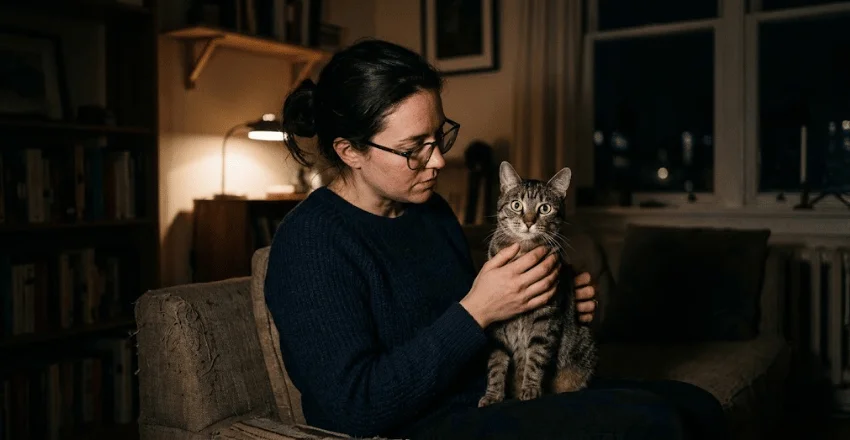
Felines see much better than people in dim conditions. They still need some light, so complete darkness prevents normal vision. Their large pupils, rod-rich retinas, and reflective eye structures help gather available light.
PetMD cites veterinary guidance that low-light vision is several times better than ours. That advantage does not create a full-color nighttime picture. As light falls, color information becomes less useful while motion and contrast remain important.
Do Toy Colors Matter?
Toy color can affect visibility, but it does not determine play interest. Movement, texture, sound, scent, and hunting style may matter more. A visible object still needs to behave like something worth chasing.
Blue or yellow toys can be practical starting points for many homes. Pick a shade that contrasts with your flooring, furniture, and bedding. You can find more everyday animal-care topics in the Readixt Pets section.
| Choice | Why it may help |
|---|---|
| Blue or yellow toys | These colors are usually easier to distinguish. |
| High-contrast backgrounds | Contrast can make an object easier to track. |
| Moving toys | Motion is an important visual cue. |
| Varied textures | Texture adds enrichment beyond color. |
| Rotating play styles | Variety can maintain interest without relying on color alone. |
What This Means Around Your Home
You do not need to redesign a room around feline eyesight. Small contrast choices can make toys, steps, and activity areas easier to notice. Strong lighting changes also matter because brightness affects how colors appear.
Use contrast around frequently used objects, especially in dim rooms. Keep pathways predictable for older pets or animals with vision changes. Mixed-pet households can also review Readixt’s dog ibuprofen safety guide for another common care question.
Frequently Asked Questions
Are cats color blind or do they only see black and white?
No, they do not see only black and white. Their color range is limited and less saturated than ours. Blues and yellows are generally easier to distinguish than reds and similar warm tones.
Can a cat see red?
Feline eyes have difficulty separating red the way humans do. It may look muted, grayish, brownish, or similar to another tone. The exact appearance can change with brightness and surrounding colors.
What color is easiest for a cat to see?
Blue is among the most reliably visible colors. Yellow also tends to stand out well. Contrast with the background can matter as much as the chosen hue.
Can a cat see green?
Green perception is less straightforward than blue perception. Some greenish tones may remain visible, while others can appear muted. Research sources differ on the exact boundaries of feline color discrimination.
Can a cat see in complete darkness?
No animal eye can form a normal visual image without incoming light. Feline eyes work extremely well with small amounts of available light. Total darkness still removes the visual information those eyes need.
Bottom line
Feline eyesight trades rich color detail for excellent low-light sensitivity and motion detection. That makes blue and yellow useful choices, while red-heavy shades may appear less distinct. The simplest improvement is pairing visible colors with strong contrast and movement.
For more practical pet-care explainers, browse the Readixt pet library. Use color knowledge as one small part of enrichment, not a strict rule. Your pet’s response to movement, texture, and play style matters more.