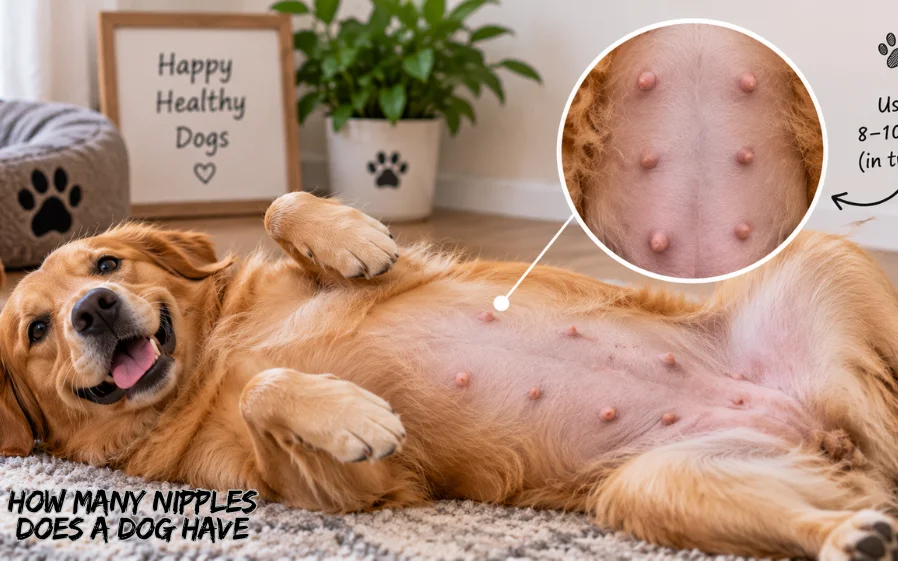
If you’ve searched “how many nipples does a dog have,” the short answer is that most dogs have around eight to 10. Ten is the usual anatomical pattern, but individual dogs can have fewer or more without anything being wrong. Both male and female dogs have nipples, and the count alone usually says little about a dog’s health.
| How Many Nipples Does a Dog Have | What dog owners should know |
|---|---|
| Typical anatomy | Five pairs, or 10 nipples |
| Common count | About 8–10 |
| Possible variation | Some dogs have fewer or more, including an odd number. |
| Male dogs | Yes, males have nipples. |
| Location | Two rows extending from the chest toward the groin |
| Main function | Mammary glands produce milk in lactating females |
| When to seek veterinary care | New lumps, pain, heat, redness, sores, or unusual discharge |
Direct answer: Most dogs have eight to 10 nipples arranged in two rows along the underside of the body. Ten, or five pairs, is the usual anatomical pattern, although normal variation occurs. Male and female dogs both have them, and an unusual count alone generally isn’t a reason for concern.
Key Takeaways
| Question | Short answer |
|---|---|
| Is 10 normal? | Yes. Five pairs is the usual canine pattern. |
| Is 8 normal? | Yes. Individual variation is common. |
| Can a dog have an odd number? | Yes. Asymmetry can occur naturally. |
| Do male dogs have nipples? | Yes. They develop before sexual differentiation is complete. |
| Does the count predict litter size? | No. It does not reliably tell you how many puppies a female can have. |
| What matters most? | Watch for changes in appearance, texture, temperature, or discharge. |
How Many Nipples Does a Dog Have, and What Count Is Normal?
Veterinary anatomy commonly describes dogs as having five pairs of mammary glands, giving a typical total of 10 nipples. Those glands form two parallel chains extending from the chest toward the groin. Scientific veterinary literature also notes that deviations from five pairs can occur, so the textbook pattern is not a rigid rule.
Many pet-health references describe eight to 10 as the range owners see most often. Some dogs may have fewer, more, or an uneven count without having a medical problem. The better question is whether each nipple has always looked that way or has recently changed.
If you enjoy practical canine health explainers, the Readixt Pets section collects related pet-care topics. Knowing your dog’s normal anatomy can make routine grooming and health checks more useful. It also makes unfamiliar bumps easier to assess before you assume something is wrong.
Where Are a Dog’s Nipples Located?
A dog’s mammary glands usually run in two lines along the underside of the body. The standard five-pair pattern includes two thoracic pairs, two abdominal pairs, and one inguinal pair. Simply put, they start near the chest and continue backward toward the groin.
| Mammary gland area | Approximate location |
|---|---|
| Cranial thoracic | Upper chest |
| Caudal thoracic | Lower chest |
| Cranial abdominal | Upper abdomen |
| Caudal abdominal | Lower abdomen |
| Inguinal | Near the groin and hind legs |
Long hair can make the upper nipples difficult to see, especially when they are small and flat. You may find them more easily by gently moving your fingertips along both sides of the belly. Comparing the same area on the opposite side can also help you recognize your dog’s normal pattern.
Do Male Dogs Have Nipples?
Yes, male dogs have nipples even though they do not normally use them to nurse puppies. Mammary structures begin forming early during embryonic development, before the reproductive organs become fully differentiated. This developmental sequence means both sexes are born with the same basic structures.
A male’s nipples are often small, flat, and easy to overlook beneath the coat. Their presence does not indicate a hormonal problem or anything unusual about the dog. You also cannot determine a puppy’s sex by counting or examining its nipples.
Mammary disease is much less common in males than in females, but it is still possible. A new lump, persistent swelling, ulceration, or discharge should therefore be assessed rather than dismissed because the dog is male. Research reviews document mammary tumors in male dogs, although such cases are uncommon.
Why Do Dogs Have So Many Nipples?
Dogs are a litter-bearing species, so females need several mammary glands that can provide milk to multiple puppies. The usual five-pair arrangement distributes these glands along much of the underside. During pregnancy and lactation, the mammary tissue changes substantially as it prepares to produce colostrum and milk.
Having 10 nipples does not mean a female will have 10 puppies. Litter size varies for many reasons, and the mammary count is not a reliable predictor of the number of pups in a particular pregnancy. A mother can also have more puppies than immediately available nursing positions, so breeders and owners must monitor whether every puppy is gaining weight.
Can a Dog Have an Odd Number of Nipples?
Yes, a dog can have an odd or asymmetrical number, even though pairs are more common. Veterinary reproductive guidance specifically recognizes that mammary structures may be asymmetric in number. If your dog has always had an uneven arrangement and each area looks healthy, the count itself is generally not a medical concern.
The key distinction is between a lifelong anatomical variation and a newly discovered bump. A small structure that has been in the same place for years differs from a mass that recently appeared or began growing. Taking an occasional photo during grooming can give you a useful visual reference for future comparisons.
What Healthy Dog Nipples Usually Look Like
Healthy dog nipples are usually small bumps that sit along the two mammary chains. Their color may match the surrounding skin or be more noticeably pink, brown, or darkly pigmented. Size and pigmentation can differ between individual animals, so there is no single appearance that every healthy dog must have.
Hormones can also change how prominent they look in females. Nipples may become larger during heat, pregnancy, nursing, or a false pregnancy because mammary tissue responds to reproductive hormones. PetMD lists swollen nipples among possible physical changes during a heat cycle, while veterinary references describe mammary enlargement during pseudopregnancy.
A useful health check compares each area with your dog’s established baseline. Look for changes in size, shape, color, firmness, and sensitivity rather than worrying about minor differences between dogs. A sudden change matters more than whether your pet matches a photo online.
Nipple, Tick, or Skin Lump? How to Tell the Difference
Owners sometimes mistake a normal nipple for a tick, especially on a dog with a short coat or dark skin. Before removing a bump, check its position, shape, and connection to the skin. Pulling on normal tissue can cause pain and injury.
| Feature | Nipple | Attached tick | Unidentified skin lump |
|---|---|---|---|
| Typical location | Along the mammary rows | Anywhere ticks can attach | Almost anywhere |
| Part of the skin | Yes. | No, attached to the surface | Usually arises from or beneath skin |
| Legs visible | No | Often visible near the attachment point | No |
| Changes quickly after feeding | No | May enlarge | Depends on the cause |
| Similar structures nearby | Often | Usually not | Usually not predictable |
| Safest response if unsure | Leave it alone and check carefully. | Confirm before removal. | Ask a veterinarian. |
If you cannot confidently identify what you are seeing, do not squeeze, cut, or pull it. A veterinarian can distinguish normal anatomy from a parasite, cyst, skin tag, or mass during an examination. This is especially useful when a bump looks different from all the others on the abdomen.
When Changes Around the Nipples Need a Veterinarian
The number is rarely the health issue, but changes in mammary tissue can matter. Mastitis is inflammation of a mammary gland and occurs most often in lactating females, particularly after giving birth. VCA notes that affected glands may become painful and inflamed, while bacterial infection is a common cause.
Contact your veterinarian if you notice any of the following signs.
- a new or enlarging lump beneath or beside a nipple
- persistent redness, warmth, or swelling
- pain when the area is touched
- blood, pus, or other unexpected discharge
- an open sore or ulcerated area
- significant changes affecting only one mammary gland
- a nursing mother who seems ill or refuses to let puppies feed
Mammary tumors are another reason to take persistent masses seriously. The Merck Veterinary Manual describes canine mammary tumors as nodules or masses that can develop around the nipples, with some lesions involving the skin. An early exam helps a veterinarian determine what the lump is and whether testing or treatment is needed.
Do not give human pain medicine because a mammary area looks sore. Several common human medications can be dangerous for pets, and treatment depends on the cause of the discomfort. Readixt’s guide to ibuprofen safety for dogs explains why you should make medication decisions with veterinary guidance.
Do Breed, Size, or Litter Size Determine the Number?
You may see claims that large breeds always have more nipples and small breeds always have fewer. Individual variation makes that rule unreliable, and dogs of the same breed can have different counts. The safest conclusion is that breed or body size cannot tell you the exact number a particular dog should have.
Litter size also does not provide a dependable way to calculate the count. Mammary anatomy develops before a female ever has puppies, and the number does not change to match each pregnancy. A dog with fewer nursing positions can still have a larger litter, although close monitoring may be needed to ensure every puppy feeds adequately.
A Simple Belly Check You Can Do During Grooming

A quick monthly look at the underside can help you learn what is normal for your pet. Start near the chest and visually follow both mammary chains toward the hind legs, noting the position and appearance of each nipple. Then use gentle fingertips to check for a new firm area beneath or beside the skin.
| Check | What you are looking for |
|---|---|
| Position | Familiar nipples in the same locations |
| Symmetry | Major new differences between opposite sides |
| Skin | Redness, sores, crusting, or irritation |
| Texture | New firmness, thickening, or a distinct lump |
| Temperature | One area that feels unusually warm |
| Discharge | Blood, pus, or unexpected fluid |
| Comfort | Flinching, guarding, or pain during gentle touch |
Do not repeatedly squeeze nipples to see whether fluid appears. Manipulation can irritate the area, and expressing milk from a pseudopregnant female can stimulate further milk production. If your check reveals something new, photograph the area and arrange veterinary advice rather than trying to diagnose it at home.
The Bottom Line for Dog Owners
Ten nipples in five pairs is the standard canine anatomical pattern, but natural variation means your dog does not need to match that number exactly. Eight, 10, an uneven count, or another lifelong variation can be normal when every area remains healthy. New changes in a mammary gland matter much more than the total count.
Use belly rubs and grooming sessions to learn what is normal for your pet. If you notice a new lump, painful swelling, discharge, or another persistent change, schedule an exam with your veterinarian. For more practical pet information, you can also browse more Readixt guides from its growing pet-care library.
Frequently Asked Questions
How many nipples does a dog have?
Most dogs have eight to 10, while 10 represents the usual five-pair anatomical arrangement. Individual animals can have fewer, more, or an asymmetrical pattern. The count alone generally does not signal a health problem unless you have mistaken a newly developed mass for a nipple.
Is it normal for a dog to have nine nipples?
Yes, an odd number can be a normal anatomical variation. Mammary structures do not have to be perfectly symmetrical in every dog. What matters more is whether the tissue looks healthy and has remained stable over time.
Do male and female dogs have the same number?
Sex does not give you a reliable way to predict the count. Males develop nipples during early embryonic development even though their mammary glands do not normally lactate. Females may have more noticeable nipples because hormones, pregnancy, or nursing can enlarge the surrounding tissue.
Why are my female dog’s nipples suddenly larger?
Heat, pregnancy, nursing, and false pregnancy can all make mammary tissue more noticeable. Enlargement accompanied by pain, heat, illness, abnormal discharge, or a distinct mass deserves veterinary assessment. Comparing the change with the other glands can give your veterinarian useful information.
Should I worry about a lump next to a nipple?
A new lump should be examined rather than diagnosed from appearance alone. Mammary tumors can present as discrete masses around the nipples, while infections and other skin conditions can produce similar-looking changes. Prompt veterinary evaluation is the safest way to determine the cause.